On the evening of June 20, 1957, residents of north Fargo looked west and saw death approaching. A massive tornado — later estimated at F5 intensity, the most powerful category — was grinding toward the city. It had already devastated the town of Golden Ridge. Now it was coming for Fargo, a churning column of destruction half a mile wide.
The tornado killed 13 people, injured more than 100, and destroyed or damaged over 1,300 homes. It was the deadliest tornado in North Dakota history. But the storm's greatest impact wasn't measured in casualties. It was measured in knowledge. Because a young Japanese scientist came to Fargo to study the wreckage, and what he learned there would revolutionize how we understand tornadoes.
His name was Tetsuya Theodore Fujita. The scale he eventually created — the Fujita Scale, ranking tornadoes from F0 to F5 — is still used today. And it all started in the rubble of Fargo.
The Storm
June 20, 1957, was a Thursday. The day had been warm and humid — classic tornado weather for the northern plains. By late afternoon, thunderstorms were building to the west. Residents of Fargo had seen storms before. They didn't think much of it.
The tornado touched down around 6:30 PM near the small community of Golden Ridge, about ten miles west of Fargo. It was already massive — witnesses described a "black wall" moving across the prairie. It obliterated Golden Ridge, killing two people, then continued east toward the city.
Fargo had almost no warning. There was no organized tornado warning system in 1957 — no sirens, no emergency broadcasts, no cell phone alerts. Some residents saw the funnel approaching and ran for shelter. Others had no idea until the tornado was on top of them.
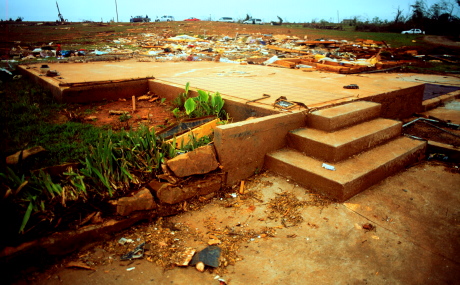
The storm cut a path through north Fargo, destroying homes, businesses, and the newly built North Fargo shopping center. Cars were thrown hundreds of yards. Houses were reduced to splinters. The tornado maintained F5 intensity for much of its path through the city — winds exceeding 260 miles per hour, the maximum rating on any scale.
"I saw the rotating cloud... it was just a monster. It was the biggest thing I had ever seen."
— Dewey Bergquist, WDAY Weatherman who filmed the tornado
The Scientist

Tetsuya Fujita was born in Japan in 1920. He had survived the atomic bombing of Nagasaki — arriving to survey the damage just weeks after the blast — and the experience shaped his scientific approach. He understood that destruction patterns could reveal forces invisible to direct observation. You could read the violence backward from the wreckage it left.
By 1957, Fujita was a researcher at the University of Chicago, studying severe storms. He was virtually unknown outside academic circles. But he had a gift for visual analysis — an ability to look at photographs and debris patterns and reconstruct the forces that created them. When news of the Fargo tornado reached Chicago, Fujita knew he had to see it.
He arrived in Fargo days after the storm, armed with cameras and notebooks. What he found was a laboratory of destruction — a complete record of tornado damage, frozen in place, waiting to be analyzed. Fujita spent weeks in Fargo, photographing everything, interviewing survivors, mapping the debris.
He collected approximately 200 photographs of the storm itself — images captured by residents and photographers as the tornado approached and struck. Nobody had ever gathered such comprehensive visual documentation of a tornado in progress. For Fujita, these photos were data.
The Method
Fujita scaled all 200 photographs to the same proportional size, then analyzed the movement of cloud formations in one-minute intervals across 150 different images. This painstaking frame-by-frame analysis — years before video technology made it easy — allowed him to track the tornado's internal structure as it evolved.
The Breakthrough
Fujita's analysis of the Fargo tornado produced groundbreaking insights. By studying the photographs and damage patterns, he identified distinct structural features of the storm that had never been formally described. He gave them names that meteorologists still use today.
The "wall cloud" — the lowered, rotating cloud base from which tornadoes descend. The "tail cloud" — a horizontal extension of the wall cloud. The "collar cloud" — a ring of cloud surrounding the upper portion of the funnel. These terms, now standard in meteorology, were coined by Fujita based on what he saw in the Fargo photographs.

More importantly, Fujita developed methods for estimating tornado intensity based on damage patterns. Different wind speeds produced different types of destruction. A storm that peeled roofing was weaker than one that leveled walls. A storm that leveled walls was weaker than one that swept foundations clean. By analyzing what was destroyed and how, you could work backward to determine the forces involved.
His 1960 paper on the Fargo tornado became a landmark in meteorological literature. It demonstrated that tornadoes could be studied systematically, their intensity estimated from their effects. It laid the groundwork for everything that followed.
"The Fargo tornado gave me the data I needed to understand how tornadoes work. Every destroyed house, every overturned car, every piece of debris told part of the story. I just had to learn how to read it."
— Ted Fujita, Interview, 1980s
The Scale

In 1971, Fujita published his most famous contribution to meteorology: the Fujita Tornado Intensity Scale. The scale rated tornadoes from F0 (light damage, winds 40-72 mph) to F5 (incredible damage, winds above 261 mph). It gave scientists and the public a common language for describing tornado severity.
The scale was built on the insights Fujita had developed studying Fargo and subsequent tornadoes. Each rating corresponded to specific damage indicators — the types of destruction that particular wind speeds would produce. An F0 might damage chimneys. An F5 would lift strong houses off their foundations and carry debris for miles.
The Fujita Scale became the universal standard for tornado measurement. When news reports describe an "F4 tornado" or "F5 damage," they're using Fujita's framework. The scale was updated in 2007 to the Enhanced Fujita Scale (EF0-EF5), incorporating new damage indicators, but the fundamental approach — rating intensity by effects — remains Fujita's.
Fujita went on to make numerous other contributions to meteorology, including identifying microbursts — sudden downdrafts that caused several airplane crashes before he explained them. He became known as "Mr. Tornado," the world's leading expert on severe storms. He died in 1998, having transformed how humanity understands its most violent weather.
The Rating
The 1957 Fargo tornado was retrospectively rated F5 on Fujita's scale — the most powerful category. Only 59 tornadoes in recorded U.S. history have received this rating. The Fargo storm remains North Dakota's deadliest tornado and one of the best-documented F5 events in history.
The Legacy

The 1957 tornado changed Fargo forever. The city rebuilt, but the memory of the storm persisted. Better warning systems were developed. Building codes were strengthened. The community that had been caught off guard vowed never to be surprised again.
But the storm's greater legacy was scientific. The research that began in Fargo's rubble led to the Fujita Scale, which led to better tornado forecasting, which led to improved warning systems across the country. Every time a tornado siren sounds, every time a meteorologist rates a tornado, every time someone survives because they had time to take shelter — they're benefiting from what Ted Fujita learned in Fargo.
The National Weather Service office in Grand Forks, which covers the Fargo area, still commemorates the 1957 tornado. The event is used for training, for public education, for understanding what maximum-intensity tornadoes can do. Fargo's tragedy became the textbook.
On June 20, 1957, a tornado killed 13 people in Fargo, North Dakota. It was a catastrophe — the worst natural disaster in the city's history. But a young scientist came to study the destruction, spent weeks analyzing photographs and debris patterns, and developed insights that revolutionized meteorology.
Ted Fujita's work on the Fargo tornado led to the Fujita Scale, the standard measure of tornado intensity that's been used for over fifty years. The terms he coined — wall cloud, tail cloud, collar cloud — are still taught to meteorology students. The methods he developed for reading destruction are still used by storm surveyors.
Fargo's disaster became science. The rubble that buried 13 people also buried the mysteries of how tornadoes work. And a scientist who knew how to read wreckage extracted knowledge that has saved countless lives since. The tornado that devastated Fargo in 1957 taught us everything we know about measuring the wind.
Remembering the Storm
The National Weather Service maintains detailed records of the 1957 Fargo tornado on its website, including damage photographs and maps. The NDSU Archives hold local newspaper coverage and survivor accounts. A memorial to the tornado victims stands in Fargo's Riverside Cemetery.