
Rain City Rising
Lumber, fish, airplanes, and the particular genius of turning gray skies into gold
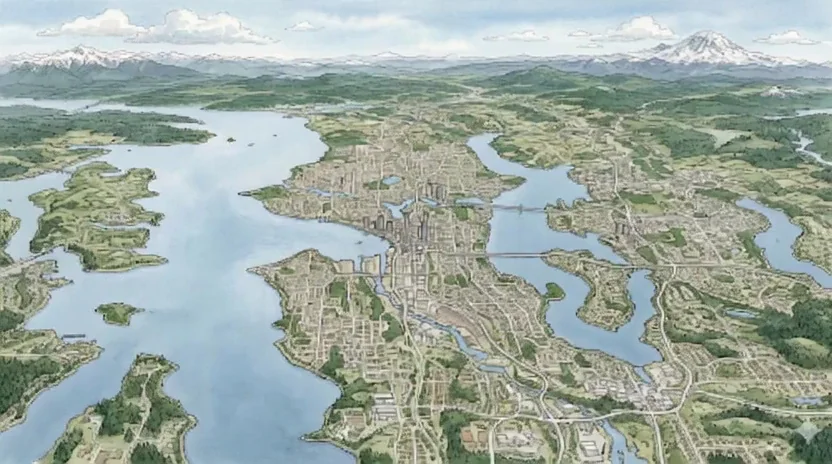
The city clings to hills between two bodies of water, Puget Sound to the west and Lake Washington to the east, the whole improbable settlement built on land so steep that early residents strung cable cars up grades that horses refused. Seattle exists because of geography and despite it—the deep harbor that could shelter ships, the timber that covered every hillside, the salmon that ran so thick in the rivers you could supposedly walk across their backs. The Duwamish and Suquamish peoples had lived here for ten thousand years, fishing and trading, before Arthur Denny's party of settlers arrived in 1851 and declared the rain-soaked wilderness a good place to build a city.
They named it after Chief Si'ahl, anglicized to Seattle, a Suquamish and Duwamish leader who reportedly objected to having his name used because his people believed the dead are disturbed when their names are spoken. The city has been disturbing him ever since, building atop the burial grounds and fishing camps, paving over the tideflats, regrading the hills, reshaping the land to suit commerce with an aggression that makes other American cities look passive. Seattle doesn't accept geography; it argues with it.
The first industry was lumber, the Douglas firs and Western red cedars that grew two hundred feet tall and ten feet wide, trees so large that early loggers spent days felling a single one. Henry Yesler built a steam-powered sawmill at the foot of what became Yesler Way, and logs skidded down the muddy street to be cut into boards—the original Skid Road, before the term meant urban decay, when it was just the path timber took to the water. The lumber ships carried Seattle's forests to San Francisco and beyond, the old-growth stripped from the hills so efficiently that photographs from 1900 show a landscape as denuded as an industrial wasteland, the stumps stretching for miles.
Ashes and Gold
The Great Fire of 1889 burned the entire downtown to the ground—thirty blocks of wooden buildings gone in twelve hours, the flames jumping from block to block while citizens dynamited structures trying to create firebreaks that never held. The city rebuilt immediately, but differently: brick and stone instead of wood, streets raised one to two stories above the original grade to solve the sewage problems that had plagued the low-lying downtown. The old storefronts became basements, connected by underground passages that tourists now walk through, the buried city beneath the rebuilt one a physical reminder that Seattle exists in layers, each era built atop the ruins of what came before.
The Klondike Gold Rush saved Seattle from post-fire poverty. When gold was discovered in the Yukon in 1897, Seattle's merchants declared themselves the gateway to Alaska, the outfitting center where prospectors should spend their money before heading north. It was marketing genius built on geographic convenience—Seattle was closer to the goldfields than San Francisco, had the harbor to handle the ships, the suppliers to sell the gear. Erastus Brainerd, hired by the Chamber of Commerce, launched one of the first modern advertising campaigns, sending promotional materials to newspapers and magazines across the country, positioning Seattle as the starting point for fortune. Most prospectors found no gold, but Seattle's merchants got rich anyway, selling them shovels and tents and passage on overcrowded steamships.
Seattle doesn't accept geography; it argues with it.
The money from the gold rush funded the next transformation. The hills were too steep for the city Seattle wanted to become, so they flattened them—Denny Hill, where a sixty-room hotel had stood, was washed into Elliott Bay using high-pressure water hoses, the land regraded over twenty years of work that created the flat downtown we see today. Jackson Street was regraded repeatedly, the Dearborn Cut carved through Beacon Hill, the original topography erased in favor of commerce. The dirt from the regrades filled the tideflats south of downtown, creating the industrial district where railroads and warehouses could sprawl on land that had been underwater.
Wings Over the Sound
Boeing arrived in 1916, William Boeing building seaplanes in a converted boathouse on Lake Union, the company that would define Seattle for the next century. The logic was simple: Seattle had water for seaplanes, timber for wooden aircraft frames, and enough distance from the established aviation centers to develop ideas unobserved. By World War II Boeing was building B-17 and B-29 bombers, the factories running twenty-four hours a day, workers flooding into Seattle from across the country. The Boeing Bust of 1971, when the company laid off sixty thousand workers, created the famous billboard: "Will the last person leaving Seattle please turn out the lights." The city nearly died, population declining, housing values collapsing, the single-industry economy exposed as fragile.
But Seattle didn't die. Microsoft was founded in Albuquerque in 1975 but moved to Bellevue in 1979, Bill Gates returning to his hometown, and by the 1990s the company had made Seattle the center of the personal computer revolution. Amazon started in a Bellevue garage in 1994, Jeff Bezos choosing Seattle for its technical talent pool and its proximity to a major book distributor in Oregon. The tech boom transformed the city again, young programmers replacing aerospace engineers, stock options replacing union wages, the blue-collar Boeing culture giving way to the hoodie-and-laptop aesthetic of the knowledge economy.
The coffee came from Starbucks, founded at Pike Place Market in 1971, though it sold only beans until Howard Schultz bought the company and turned it into the espresso-bar chain that colonized the world. Seattle became synonymous with coffee culture—not because people here drink more coffee than elsewhere, but because the gray skies and long winters create a need for warm drinks and third places, for somewhere to sit and read while the rain falls outside. The independent coffee shops preceded Starbucks and persist alongside it, roasters like Victrola and Caffe Vita and Espresso Vivace maintaining the craft tradition while Starbucks standardizes it for global export.
The Sound of the Underground
The music scene erupted in the late 1980s, bands playing in basements and all-ages clubs, the sound that would be called grunge emerging from the collision of punk and metal in a city isolated enough to develop its own aesthetic. Nirvana and Pearl Jam and Soundgarden and Alice in Chains—Seattle bands suddenly everywhere, flannel shirts and torn jeans becoming fashion, the city's insularity broadcast globally. Kurt Cobain shot himself in a greenhouse in the Madrona neighborhood in 1994, and the grunge moment ended as quickly as it had begun, though the music persists in tribute bands and nostalgia and the continued presence of bands that survived their moment.
Seattle exists in layers, each era built atop the ruins of what came before.
The Seattle Freeze is what transplants call the social distance that natives deny. People here are polite but not warm, friendly in ways that don't lead to friendships, willing to make plans that somehow never materialize. The explanations vary—Scandinavian reserve, the weather that keeps people indoors, the tech culture that attracts introverts—but the effect is real: newcomers report years of struggle to build social connections, the city welcoming on the surface but difficult to penetrate. The rain doesn't help, nine months of gray drizzle that arrives in October and lifts in July, the kind of weather that encourages hibernation and introspection rather than street life and spontaneous interaction.
The WTO protests of 1999 announced Seattle to the world in a different way—fifty thousand demonstrators shutting down the World Trade Organization meetings, tear gas in the streets, anarchists smashing Starbucks windows while union members marched peacefully, the whole thing broadcast as chaos though most of the city continued normally. It was the birth of the modern anti-globalization movement, or at least its American debut, Seattle as the stage for a confrontation that prefigured Occupy Wall Street and the protests that followed. The police response was brutal and poorly coordinated, the mayor eventually apologizing, the National Guard called in, the city's progressive self-image confronting the reality of how it treats dissent.
The Price of Prosperity
The homelessness is visible and worsening, tent encampments under freeway overpasses, in parks, along arterials, the crisis driven by housing costs that have made Seattle one of the most expensive cities in America. The tech wealth flows to landlords and homeowners, pricing out the service workers and artists and teachers who can't compete with software engineer salaries. The suburbs sprawl eastward, Bellevue now a city in its own right, Redmond and Kirkland and Issaquah filling with the people who can't afford Seattle proper but need to be close enough to commute.
The neighborhoods gentrify in waves—Capitol Hill was bohemian before it was gay before it was expensive, Ballard was Scandinavian fishing families before it was hipsters before it was tech workers, Columbia City was Black before it was diverse before it was coveted. The displacement follows a pattern: artists discover cheap rent, make a neighborhood interesting, attract attention that raises prices, price themselves out, move further south or east, repeat. The Central District, historically the heart of Black Seattle, is now majority white, the jazz clubs and soul food restaurants replaced by craft breweries and yoga studios.
Pike Place Market persists as the symbol of what Seattle was and claims to still be—fishmongers throwing salmon, farmers selling produce, craftspeople displaying wares, the last remaining operating market of a system that once fed the city. The tourists crowd the aisles, photographing the fish throwing, buying the first Starbucks location's merchandise, unaware that the market almost became a parking garage in the 1960s before citizen activism saved it. It's preserved now, a living museum of the pre-tech economy, the market that refuses to be a mall though the pressure is constant.
The Space Needle rises 605 feet, the legacy of the 1962 World's Fair that announced Seattle as a city of the future. The fair brought the monorail, still running its one-mile route from downtown to Seattle Center, a transportation system that was supposed to expand and never did. The needle itself is mainly a tourist attraction now, the views of the Olympics and the Cascades and Mount Rainier—when the mountain is "out," visible through the clouds—the reason people still pay to ride to the top. The skyline has grown around it, Amazon's spheres and the new office towers making the needle look smaller than it once did, the symbol of future becoming a relic of past futures.
To live in Seattle is to live with the water—the Sound and the lakes and the ship canal and the rain that falls steadily from autumn to summer, the dampness that grows moss on rooftops and mold in basements and green on every surface that holds still long enough. The ferries cross to Bainbridge and Bremerton, commuters reading on the upper decks, the mountains visible on clear days, the whole transit system a reminder that Seattle is not one place but a collection of places linked by bridges and waterways.
The mountains frame everything—the Cascades to the east, the Olympics to the west, Mount Rainier to the south rising 14,411 feet, so large it creates its own weather, visible from a hundred miles away on clear days, the defining landmark of the region. The locals call it "the Mountain" as if there were only one, and on the days when it emerges from the clouds, everyone stops to look, to point, to take photographs that never capture the scale. The city exists in its shadow, built on its volcanic debris, aware at some level that Rainier is not just beautiful but dangerous, an active volcano that could bury communities under mudflows if it decided to wake.
The tech money continues to flow, Amazon's second headquarters downtown having reshaped South Lake Union from a neighborhood of warehouses and small businesses into a canyon of glass towers, the company's spheres glowing at night like alien pods, the workforce of badge-wearing employees flooding the sidewalks at lunch. Microsoft and Google and Facebook and the rest have offices here, the competition for talent driving salaries that make six figures feel inadequate, the whole economy tilted toward people who can code while everyone else scrambles to afford the city they built.
Seattle persists between the water and the mountains, the rain and the occasional sun, the old industries and the new money, the progressive politics and the resistant neighborhoods, the dream of what it wants to be and the reality of what it has become. The ferries still cross the Sound. The fish still fly at Pike Place. The coffee still pours in shops where people work on laptops, building the next thing, convinced that here, in this gray and green and water-wrapped city, they can make something that matters. The rain falls, and the cranes rise, and the city continues its argument with geography, building higher and denser and more expensive, still believing that the future belongs to whoever is willing to get wet for it.